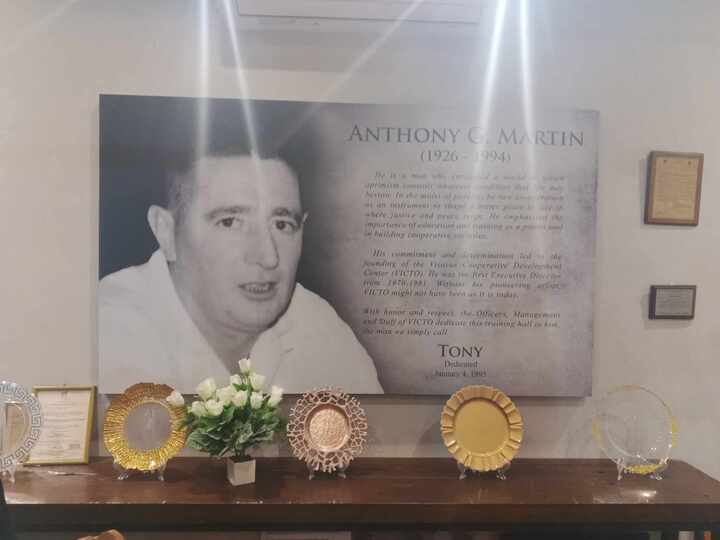
August 26, 1926—Born in Newfoundland, Canada.
December 8, 1955—Ordained as a Catholic Priest with the Scarboro Foreign Missions, based in Canada.
June 1958—Sent to the Philippines, specifically to Cabali-an, Southern Leyte.
June 1961—Appointed Parish Priest of Hinundayan, Southern Leyte.
1964—Organizes the San Jose Parish Credit Union in Hinundayan, Southern Leyte.
1962—1969—Establishes credit unions in Anahawan, Hinunangan, St. Bernard, and Cabali-an.
September 1966—Becomes Regional Superior of all Scarboro Missions Priests in the Philippines.
March 1970—Joins NASSA (National Secretariat for Social Action) of the Catholic Bishops' Conference of the Philippines, which establishes an office in Cebu.
May 1972—Leaves NASSA to found VOICE (Visayas Office for Information on Cooperative Education) with financing from MISEREOR. VOICE would later be renamed VICTO (Visayas Cooperative Training Organization).
December 1972—Leaves the Catholic Church and continues as CEO of VICTO.
April 26, 1976—Becomes a Filipino citizen to lead VICTO and prevent the Philippine government from deporting him back to Canada.
1977—In collaboration with Germany’s FES, organizes NATCCO (National Training Center for Cooperatives), which would later be renamed the National Confederation of Cooperatives. Serves as president of NATCCO for five years, from 1977 to 1982.
1982—Resigns from VICTO and NATCCO.
1982—1994—Rejoins the Catholic Church, focusing on organizing Basic Ecclesial Communities.
October 21, 1994—Dies and is laid to rest at Queen’s City Cemetery in Cebu City.
**Leadership Through Sacrifice: April 26, 1976**
Under the shadow of martial law, Tony Martin chose to share the fate of the Filipino people by becoming one of them. He applied for Filipino citizenship, asserting that it was crucial for his mission of establishing credit unions in the Philippines. The civilian-military establishment viewed his efforts to organize the poor into cooperatives as akin to promoting socialism and communism. The 1970s remained deeply entrenched in the Cold War. Despite this suspicion, Tony Martin was granted Filipino citizenship on April 26, 1976.
Unbeknownst to Philippine authorities, Martin had been aware that a fellow Canadian missionary priest, Fr. Harvey Steele, had been deported from the Dominican Republic by the dictator Rafael Trujillo. Fr. Steele had also established credit unions in that country but became a target due to his social justice efforts on behalf of the poor.
By staying one step ahead of the authorities, Martin thwarted any attempts by the Philippine government to deport him back to Canada. He continued to lead VICTO and NATCCO through the tumultuous events of the 1970s and 1980s.
After 36 years of dedicated service to the Filipino people, Tony Martin passed away on October 21, 1994, and was laid to rest in Queens Cemetery in Cebu City.
From Canada to the Philippines:
Anthony “Tony” Martin was born on August 28, 1926, in Newfoundland, Canada, to parents of differing religious backgrounds: his father was a Protestant, and his mother a Catholic. Ultimately, he embraced Catholicism and became a priest, largely influenced by his mother’s strong beliefs.
In 1958, Tony joined the Scarboro Foreign Missions and was assigned to the Philippines. There, in the parish of Hinundayan, Southern Leyte, he was confronted with alarming poverty as farmers struggled in a relentless cycle of debt.
Drawing on the resources of the Scarboro Missions and leveraging their expertise in establishing Credit Unions in the Dominican Republic, Tony Martin organized a series of Credit Unions across five parishes: Hinundayan, Hinunangan, St. Bernard, Anahawan, and Cabali-an.
Although a Catholic Priest, Tony Martin did not staunchly defend the Catholic faith. His guiding principles—“God does not intervene in human affairs” and “Only man can solve man’s problems”—prompted him to prioritize social action over religious formalities in the quest to combat economic inequality.
In 1972, he left the Scarboro Missions to fully dedicate himself to the establishment of Credit Unions in the Philippines. By collaborating with agencies like Canada’s CIDA, the United States’ USAID, and Germany’s MISEREOR and FES, Tony Martin founded VOICE/VICTO between 1970 and 1972, followed by NATCCO in 1977.
Tony Martin passed away on October 21, 1994, in Cebu City, after 36 years of dedicated service to the Filipino people.